Best Compact AI Workstations in 2026: DGX Spark & GB10 Rivals
We compare NVIDIA DGX Spark, Dell Pro Max GB10, ASUS Ascent GX10 and other personal AI supercomputers for local LLM work.
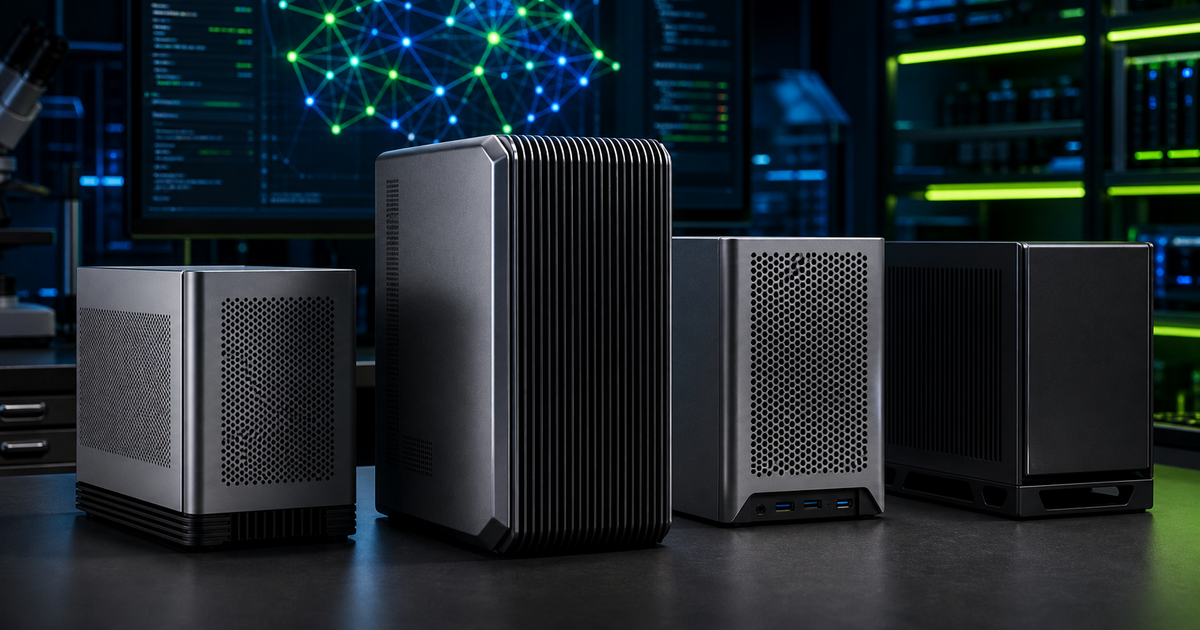
Compact GB10 workstations put 128GB of coherent memory and the CUDA software stack on a desk without a tower full of GPUs. That makes them compelling for private local inference, prototyping and model fine-tuning—but not automatically faster than every conventional workstation. Most systems below share the same Grace Blackwell module, so cooling, SSD capacity, serviceability, vendor support and price determine the real winner.
Dell Pro Max with GB10 is our best overall compact AI workstation because its serviceable design and enterprise support address the practical weaknesses of the reference box. NVIDIA DGX Spark remains the safest software-reference choice, while ASUS Ascent GX10 is the value pick when a lower-capacity configuration is meaningfully cheaper. If your workload fits into conventional GPU VRAM, compare an RTX workstation before buying any GB10 system.
🎙️ Listen to this review
AI podcast · Alex & Sam · 4 min 9s
Quick comparison
| Product | Best for | Typical price | Rating |
|---|---|---|---|
| Dell Pro Max with GB10 | Best overall | From about $3,999 | 4.8/5 |
| NVIDIA DGX Spark | Best reference platform | About $3,999 | 4.7/5 |
| ASUS Ascent GX10 | Best value GB10 | From about $2,999 | 4.7/5 |
| GIGABYTE AI TOP ATOM | Best for AI TOP ecosystem | About $3,999 | 4.5/5 |
| MSI EdgeXpert | Best ready-made cluster option | About $4,000 each | 4.4/5 |
Dell Pro Max with GB10
GB10 · 128GB unified · up to 4TB · ConnectX-7
Dell takes the same core GB10 proposition and wraps it in a more maintainable workstation. Accessible storage and enterprise procurement matter when the machine is doing real development work instead of sitting on a reviewer’s desk.
What we like
- ✓ More serviceable chassis than reference designs
- ✓ Strong business support and deployment options
- ✓ Excellent capacity for large local models
Trade-offs
- – Still expensive per token compared with some alternatives
- – Arm Linux can complicate niche software
Best for: Teams that value support, repairability and repeatable fleet purchases.
Check price on Amazon From about $3,999NVIDIA DGX Spark
GB10 · 128GB unified · 4TB Gen5 NVMe · DGX OS
DGX Spark is the known quantity and the platform documentation targets first. It can prototype and fine-tune locally before workloads move to larger NVIDIA infrastructure, but buyers should understand that huge memory capacity—not record token generation—is the main attraction.
What we like
- ✓ Canonical NVIDIA software experience
- ✓ Compact one-litre design
- ✓ 200Gb-class ConnectX-7 for two-node workflows
Trade-offs
- – Limited internal serviceability
- – 273GB/s memory bandwidth constrains generation speed
Best for: CUDA developers who want the cleanest reference environment and documented two-node path.
Check price on Amazon About $3,999ASUS Ascent GX10
GB10 · 128GB unified · 1TB/2TB/4TB options
Because the compute module is effectively the same, the GX10 becomes compelling whenever its 1TB or 2TB version undercuts the 4TB reference machines. Add network storage or upgrade later if your datasets do not need to live entirely inside the box.
What we like
- ✓ Lower-cost storage configurations
- ✓ Same essential GB10 compute
- ✓ Compact chassis with standard connectivity
Trade-offs
- – Lower-capacity models may use Gen4 storage
- – Price advantage changes frequently
Best for: Individual developers who want GB10 memory capacity at the lowest sensible entry price.
Check price on Amazon From about $2,999GIGABYTE AI TOP ATOM
GB10 · 128GB unified · 4TB Gen5 NVMe
The ATOM is another capable interpretation of the shared GB10 board. Its appeal is strongest for buyers already using GIGABYTE’s AI TOP ecosystem or finding it discounted with better local availability than NVIDIA’s own unit.
What we like
- ✓ Full 4TB configuration
- ✓ AI TOP tooling and familiar mini-PC styling
- ✓ Same high-speed networking platform
Trade-offs
- – Little performance differentiation
- – Support experience may vary by region
Best for: Developers already invested in GIGABYTE hardware and local support.
Check price on Amazon About $3,999MSI EdgeXpert
GB10 · 128GB unified · 4TB · single/two-pack
MSI leans into the dual-node story with paired configurations. That can suit distributed experiments and teams that already know their software scales, but buying two machines does not magically make every model or framework see one giant accelerator.
What we like
- ✓ Available in coordinated two-unit bundles
- ✓ 4TB Gen5 storage
- ✓ Compact standardised deployment
Trade-offs
- – Two nodes are costly and do not behave like one simple 256GB GPU
- – Same platform bottlenecks as other GB10 boxes
Best for: Experienced teams with distributed workloads and a tested scaling plan.
Check price on Amazon About $4,000 eachHow to choose
Memory capacity is the headline advantage
The 128GB coherent pool can run models that do not fit on a 24GB or 32GB graphics card, although capacity does not equal high bandwidth.
One petaflop needs an asterisk
The headline figure is low-precision FP4 AI throughput. It is not a general-purpose benchmark and should not be compared directly with FP32 or FP64 results.
Arm compatibility matters
The Grace CPU uses Arm. NVIDIA supports its AI stack well, but proprietary x86 tools, drivers and containers may need alternatives or rebuilding.
Cloud may still be cheaper
Occasional experiments are often cheaper to rent. Local hardware makes more sense for privacy, predictable heavy use and offline workflows.
Treat OEM variants as one platform
Performance is broadly similar across GB10 designs. Buy on current price, SSD, acoustics, thermals, warranty and service.
Ready to buy?
Check current availability for our recommended picks:
Dell Pro Max with GB10From about $3,999NVIDIA DGX SparkAbout $3,999ASUS Ascent GX10From about $2,999GIGABYTE AI TOP ATOMAbout $3,999How we researched
We compared manufacturer specifications, current platform documentation, retail pricing and independent hands-on reporting. We prioritised complete ownership experience and fit for purpose over a single benchmark or headline feature.
- NVIDIA DGX Spark overview
- Dell Pro Max GB10 testing
- GB10 platform comparison
- NVIDIA GB10 technical discussion
Frequently asked questions
What can a DGX Spark-class workstation run?
Its 128GB coherent memory is suited to large local language-model inference, development and some fine-tuning workflows that exceed normal consumer GPU memory.
Are all GB10 workstations equally fast?
Core compute is broadly similar because they use the same module. Cooling, firmware and power tuning can create modest differences, but storage, support and price are usually more important.
Is DGX Spark good for gaming?
No. It is an Arm-based Linux AI development workstation, not a gaming PC.
Should I buy one instead of using the cloud?
Buy local for privacy, offline work or sustained predictable use. For occasional access to faster accelerators, cloud rental is often better value.