Best AI Agent Setups in 2026: OpenClaw, Codex & More
Six agent stacks that are genuinely useful—from an always-on assistant in Discord to controlled production workflows.
Listen to this guide
AI podcast · Alex & Sam · 3 min 48s
The best AI agent setup is not the one with the most agents. It is the smallest system that can finish your work reliably, show what it did, and stop before it causes damage. In July 2026, that usually means choosing between three different categories: an always-on personal gateway, a repository-bound coding agent, or a production workflow runtime.
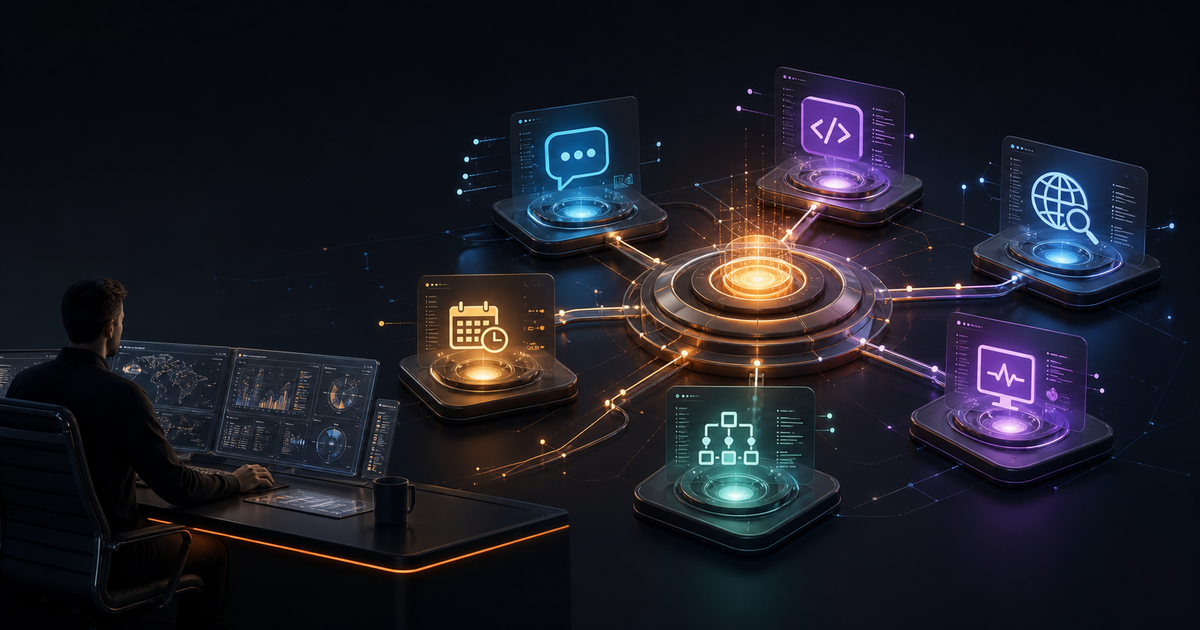
OpenClaw is our best overall agent setup for individuals and small teams because it joins chat access, tools, memory, scheduled work, skills and multiple model providers in one self-hosted gateway. It is not automatically the best choice for every task. Codex is more focused for everyday software development, Claude Code is built for enormous codebase jobs, and LangGraph gives engineering teams tighter production control.
The short answer
- Best overall personal/work agent: OpenClaw
- Best everyday multi-agent coding setup: OpenAI Codex
- Best for huge codebase workflows: Claude Code
- Best Gemini-native development setup: Google Antigravity
- Best production agent runtime: LangGraph
- Best quick role-based agent team: CrewAI
AI agent setups compared
| Setup | Best for | Runs where | Control level | Main cost |
|---|---|---|---|---|
| OpenClaw | Always-on personal and team automation | Your machine or server | High, if configured properly | Free software + model/hosting usage |
| Codex | Parallel repository work | Desktop, CLI, IDE and cloud | High inside a scoped workspace | ChatGPT plan or API usage |
| Claude Code | Large codebase analysis and migrations | CLI, desktop, IDE and API | High, but workflows can fan out widely | Plan/API usage; dynamic workflows use more tokens |
| Antigravity | Gemini-first app development | Local desktop command centre | High with managed local agents | Google plan/API usage |
| LangGraph | Reliable production workflows | Your application infrastructure | Very high and explicit | Engineering, hosting, models and observability |
| CrewAI | Role-based business automations | Python app or managed platform | Medium to high | Engineering, models and optional platform |
1. OpenClaw — best overall agent setup
Best for: a personal or small-team assistant you can message from anywhere.
OpenClaw is an MIT-licensed, self-hosted gateway that connects AI agents to Discord, Slack, Telegram, WhatsApp, Signal, Teams, iMessage and other channels. One gateway manages sessions, routing and channel connections. Its agent runtime adds tools, skills, memory, cron jobs, webhooks and multi-agent routing, while model-provider support lets you use a frontier API, local model or failover combination.
That makes it the closest thing in this guide to an agent operating system. A good OpenClaw deployment can research a topic, edit local files, run a scheduled report, respond in a team channel and hand a bounded coding job to a specialist agent without forcing you into six separate dashboards.
The flexibility is also the risk. A chat-connected process with shell access, browser sessions and credentials has a much larger blast radius than a chatbot. Keep each agent in its own workspace, allowlist senders and channels, require mentions in group chats, scope credentials to the minimum permissions, and place risky tools behind approval or a sandbox. Do not give a general-purpose agent unrestricted production keys.
- Pros: always available; self-hosted; open source; many chat channels; scheduled automation; reusable skills; multi-agent routing; provider flexibility.
- Cons: requires operations and security work; model and server costs remain; too many tools can make behaviour harder to predict.
- Ideal stack: OpenClaw Gateway on a small always-on server, Discord or Telegram as the interface, a strong default model, isolated workspaces, scoped secrets, nightly backups and alerts for failed cron tasks.
Explore the official OpenClaw docs →
2. OpenAI Codex — best everyday multi-agent coding setup
Best for: developers who want several coding tasks moving in parallel without building their own orchestrator.
The Codex app, CLI and IDE workflows are centred on repositories. Agents can inspect code, edit files, run commands and tests, and work in parallel on independent tasks. Codex also supports explicit subagents: one parent agent can delegate bounded investigations or implementation work and collect the results into a single response.
This setup is most effective when the repository already has tests, type checks, linting and a clear agent instruction file. Give each agent one outcome and a clean worktree. Keep architecture decisions with the lead agent or human; let subagents handle separable jobs such as test coverage, documentation, migration inventories and isolated components.
Codex is not an always-on personal assistant in the OpenClaw sense. It is strongest when the scope is a codebase and the finish line is a verified diff. Pairing the two can work well: OpenClaw handles channels, schedules and business context, then dispatches repository work to Codex.
- Pros: excellent repository context; parallel agents; command and test execution; clean separation through worktrees; strong reviewable outputs.
- Cons: coding-focused rather than a general life assistant; careless parallel agents can overlap; autonomous changes still need review.
- Ideal stack: Codex app or CLI, one worktree per task, mandatory test commands, protected main branch, least-privilege environment variables and human review before deploy.
See the official Codex app overview →
3. Claude Code — best for huge codebase workflows
Best for: long-running audits, migrations and codebase-wide engineering.
Claude Code's dynamic workflows can write orchestration scripts, split a difficult problem into subtasks and run tens to hundreds of subagents in parallel. Results are independently checked before being folded into one coordinated answer, and progress is saved so an interrupted job can resume. Anthropic positions the feature for codebase-wide bug hunts, security audits, framework migrations and work that benefits from adversarial review.
This is the most powerful large-scale coding setup here, but it should not be your default response to a small ticket. Anthropic explicitly warns that dynamic workflows consume substantially more tokens than a normal Claude Code session. Start with a sharply scoped task, inspect the proposed workflow, cap permissions, and require tests plus human approval for every merge.
- Pros: exceptional large-context collaboration; massive parallel workflows; independent checking; resumable long jobs; strong writing and architectural reasoning.
- Cons: potentially high token spend; parallelism can hide duplicated effort; too heavy for routine fixes.
- Ideal stack: Claude Code with normal single-agent mode by default, dynamic workflows only for codebase-scale work, an isolated branch, explicit acceptance tests and a separate reviewer.
Read Anthropic's dynamic workflows guide →
4. Google Antigravity — best Gemini-native development setup
Best for: developers invested in Gemini, Google Cloud and multimodal app building.
Google Antigravity is an agent-first development platform and local desktop command centre for steering multiple coding agents. Antigravity 2.0 is designed to take an idea through planning, implementation and verification, with local agents coordinated from one workspace. Its natural advantage is access to Google's Gemini models, multimodal capabilities and Cloud deployment ecosystem.
Choose it when your application already lives in Google Cloud, depends heavily on image, video or document understanding, or your team wants a graphical command centre rather than a terminal-first workflow. Teams outside that ecosystem may get more portable workflows from Codex or Claude Code.
- Pros: Gemini-native; multimodal strengths; local multi-agent command centre; strong path into Google Cloud.
- Cons: ecosystem lock-in; newer workflows have less accumulated practice than established coding tools; availability and plan limits can change.
- Ideal stack: Antigravity desktop, Gemini 3.5 Flash for fast iterative tasks, a stronger model for final review, Cloud staging environment and explicit deploy approvals.
5. LangGraph — best production agent runtime
Best for: software teams that need reliable state, recovery and human approval in production.
LangGraph is a low-level orchestration framework and runtime for stateful agents. Instead of telling a “crew” to solve a problem and hoping it converges, you model the process as nodes, transitions and persisted state. That supports durable execution, memory, streaming, human-in-the-loop checkpoints and recovery from partial failure.
For customer-facing or regulated systems, this explicitness is a feature. A refund agent can gather evidence, classify the case, pause for approval above a threshold, execute one authorised action and write an audit record. You can inspect exactly where the workflow is and retry the failed step rather than restarting an opaque conversation.
The trade-off is engineering effort. LangGraph is closer to application infrastructure than a ready-made personal assistant. You need to design state schemas, queues, idempotent tools, monitoring, evaluation data and deployment.
- Pros: explicit control flow; durable state; human approval; recoverability; model-agnostic; suited to production.
- Cons: steeper learning curve; more code and infrastructure; easy to over-engineer a simple automation.
- Ideal stack: LangGraph service, PostgreSQL state, queue-backed workers, LangSmith or equivalent tracing, model routing, strict tool schemas, evaluation suite and approval gates for irreversible actions.
6. CrewAI — best quick role-based agent team
Best for: clear business workflows that map naturally to specialist roles.
CrewAI lets you define agents with roles, goals and tools, group them into crews, and connect deterministic steps with Flows. It is easier to explain to a non-specialist team than a state graph: a researcher gathers sources, an analyst extracts findings, a writer drafts, and a reviewer checks the output.
That simplicity makes CrewAI a good prototype and internal-automation choice. The danger is treating role play as reliability. Multiple agents can repeat the same error or amplify a bad source. Use structured outputs, source requirements, deterministic validation and an approval step. For complex, long-lived production state, LangGraph generally gives more precise control.
- Pros: intuitive mental model; fast Python setup; clear delegation; good balance of Crews and deterministic Flows.
- Cons: extra agents add cost without guaranteed quality; less explicit state control than LangGraph; observability still needs design.
- Ideal stack: CrewAI Flow as the backbone, two or three genuinely distinct roles, structured schemas, source citations, a cheap model for routine stages and a stronger reviewer model at the end.
Three agent setups we would actually deploy
1. Personal operator setup
OpenClaw + Discord or Telegram + one frontier model + isolated skills. Run the gateway on a small server, restrict who can message it, keep each project in a separate workspace, schedule only reversible read/report tasks at first, and send completion or failure notifications back to chat. Add write credentials one service at a time.
2. Small software team setup
OpenClaw for intake and scheduling + Codex for repository execution. OpenClaw collects requests from a private channel and maintains project context. Codex works in a clean branch or worktree, runs required checks and returns a diff. A human approves the pull request and production deploy.
3. Production customer workflow
LangGraph + database + queue + tracing + approval gates. Keep model calls inside a deterministic graph, make every tool idempotent, persist state after each step, log model and tool inputs, and require human approval before money movement, account changes, external messages or destructive operations.
The safety checklist most agent guides skip
- Separate identity: use a dedicated agent account, inbox and API credentials—not your personal login.
- Least privilege: give each tool only the read or write scope it needs.
- Workspace isolation: keep unrelated projects and clients in different workspaces or containers.
- Human gates: require confirmation before sends, purchases, deploys, deletions and permission changes.
- Tool allowlists: start with a small set; more tools create more unexpected paths.
- Untrusted input handling: treat web pages, emails, documents and chat messages as data, never instructions with automatic authority.
- Budget limits: cap tokens, runtime, subagent count and paid API spend.
- Logs and alerts: retain an audit trail and notify a human when scheduled jobs fail or permissions are denied.
- Backups and rollback: version prompts, skills, configuration and files so an agent mistake is recoverable.
- Evaluation: test against real tasks and failure cases before expanding access.
How to choose
Choose OpenClaw when you want one assistant across chat, files, tools and schedules. Choose Codex when the job begins and ends in a repository. Choose Claude Code when the repository job is so large that a coordinated, long-running workflow is justified. Choose Antigravity for a Gemini and Google Cloud-centred development experience. Choose LangGraph when reliability, state and auditability matter more than setup speed. Choose CrewAI when your workflow maps cleanly to a few specialist roles and you want to prototype quickly.
Final verdict
OpenClaw is the best AI agent setup overall in July 2026 because it solves the broadest practical problem: turning model intelligence into an always-available assistant that can operate through the communication tools you already use. Its self-hosted, provider-flexible architecture also avoids locking the whole system to one model.
For most people, the winning combination is not OpenClaw or a coding agent. It is OpenClaw as the controlled gateway, with Codex or Claude Code used as a specialist inside a sharply bounded repository workflow. When the automation becomes customer-facing or financially consequential, move the critical path into an explicit runtime such as LangGraph.
Sources
Start with the right agent stack
Our top three setups for most readers: